
Blog
What Is a Bucket Filling Machine and How Does It Work?
A Bucket Filling Machine is a specialized packaging system designed to dose products into pails, tubs, and industrial buckets with controlled speed and accuracy. It may handle liquids, powders, granules, pastes, or other free-flowing materials. The machine typically positions an empty bucket, weighs or measures the required product, fills the container, and moves it toward sealing or labeling. The details matter. A small dosing error can create product waste, inconsistent quality, or rejected shipments.
Industry demand is closely connected to automation and packaging efficiency. PMMI’s 2024 State of the Industry report identifies labor availability, production efficiency, and automation as continuing priorities for packaging manufacturers. The World Packaging Organisation’s Global Packaging Trends research also emphasizes better resource use, improved filling accuracy, and more reliable packaging operations. These findings help explain why manufacturers increasingly evaluate automated filling equipment instead of relying only on manual handling.
Inside a Bucket Filling Machine, sensors detect the container and confirm its position before filling begins. A load cell may measure weight, while a piston, auger, pump, or gravity valve controls product flow. The control system then compares the measured result with the target value. It can correct small variations during production. That assumption needs testing. Product viscosity, temperature, bucket shape, dust, and operator setup can all affect performance. No machine is universally ideal. A system suitable for thick adhesive may perform poorly with lightweight powder. Understanding these practical differences is essential when comparing machine designs, cleaning requirements, accuracy claims, and total operating costs.
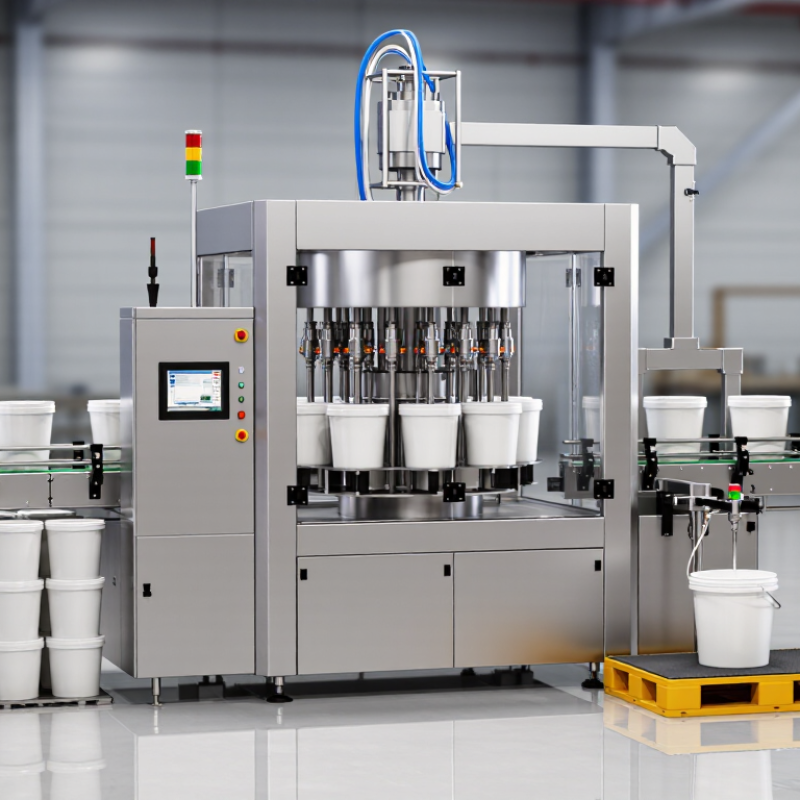
Bucket Filling Machines: Definitions, Types, and Typical 10–60 Buckets/Minute Output
A bucket filling machine measures and dispenses products into open containers with controlled accuracy. It may handle powders, granules, liquids, or semi-viscous materials. A typical system includes a hopper, weighing or metering device, filling head, conveyor, and control panel. The machine positions an empty bucket, releases a measured amount, then moves it toward sealing or labeling equipment.
Different types suit different materials and production needs. Volumetric fillers use a fixed chamber for consistent product volume. Weighing fillers check the bucket’s actual mass, making them useful when density changes during production. Auger fillers suit powders, while piston or pump fillers handle liquids and thicker products. Multi-head systems can improve speed, but they usually require more space and careful calibration.
Typical output ranges from 10 to 60 buckets per minute. The actual rate depends on bucket size, fill weight, product flow, and operator handling. A small, free-flowing material may approach the upper range. Sticky or dusty material can reduce production speed. In field evaluations, the rated figure often excludes stoppages for cleaning, refilling, or container alignment. That detail matters. A slower machine may deliver better accuracy and less waste. Testing the product before purchase remains essential, because published capacity is not always the working capacity.
What Is a Bucket Filling Machine and How Does It Work? - Bucket Filling Machines: Definitions, Types, and Typical 10–60 Buckets/Minute Output
| Data Dimension | Definition or Typical Value | How It Works or Why It Matters |
|---|---|---|
| What is a bucket filling machine? | An automated or semi-automated system that dispenses a measured quantity of product into buckets or pails. | It combines container positioning, product dosing, filling, and commonly discharge or conveying in one production process. |
| Typical products | Powders, granules, pellets, liquids, pastes, creams, and other free-flowing or semi-flowing materials. | The product’s density, flowability, viscosity, particle size, and tendency to foam determine the suitable filling method. |
| Common bucket sizes | Approximately 1–25 kg or about 1–25 L, depending on the container and product density. | The machine must be adjusted for bucket diameter, height, opening shape, target weight, and filling head clearance. |
| Typical output range | Approximately 10–60 buckets per minute. | Actual output depends on the dosing method, bucket size, product behavior, filling accuracy, operator loading, and the number of filling heads. |
| Manual or semi-automatic type | Typically about 5–20 buckets per minute, depending on operator handling and product flow. | An operator places the bucket under the filling nozzle, while the machine controls dosing and may stop automatically at the target quantity. |
| Automatic inline type | Typically about 10–40 buckets per minute. | Buckets are indexed or continuously conveyed through filling stations with limited operator intervention. |
| Automatic rotary type | Typically about 30–60 buckets per minute when using multiple filling positions. | Several buckets are processed around a rotating table, allowing filling, weighing, settling, and discharge to occur at different stations. |
| Net-weight filling | The product is dispensed into a bucket positioned on a weighing platform or load-cell assembly. | The controller stops or slows product flow when the measured net weight reaches the programmed target. |
| Gross-weight filling | The bucket and its contents are weighed together during filling. | The control system uses the total measured weight and compensates for the known empty-container weight. |
| Volumetric filling | A fixed volume is dispensed using a cup, piston, auger, or similar metering device. | It can provide high speed, but the delivered mass may vary when product density or compaction changes. |
| Auger filling | A rotating screw conveys a controlled volume of powder into the bucket. | It is commonly used for powders and can use coarse and fine dosing speeds to improve accuracy. |
| Gravimetric or linear weighing | Product is fed by a vibratory feeder, belt, gate, or similar device while the bucket is weighed. | This method is suitable for many dry products and can provide controlled bulk and dribble feeding. |
| Liquid filling | Liquid is delivered through a nozzle using time, flow measurement, piston displacement, or weight feedback. | Nozzle design and filling speed must account for viscosity, foaming, dripping, and the required fill level. |
| Bucket infeed | Buckets may be loaded manually or supplied automatically by a conveyor, denester, or container magazine. | Reliable infeed prevents empty positions, misalignment, and interruptions to the filling cycle. |
| Container positioning | Guides, clamps, indexing stops, or star wheels hold each bucket beneath the filling head. | Accurate positioning reduces spills and ensures that the product enters the container rather than the surrounding equipment. |
| Standard operating sequence | Feed bucket → detect position → tare or confirm container → bulk fill → fine fill → verify weight or level → release bucket. | Sensors and a programmable controller coordinate the sequence and can stop the machine when a fault is detected. |
| Typical accuracy | Often within approximately ±0.1% to ±1% of target weight, depending on the product and filling system. | The stated accuracy is application-dependent and should be confirmed through product trials and calibration. |
| Typical control components | Programmable controller, human-machine interface, photoelectric sensors, load cells, pneumatic valves, and variable-speed drives. | These components manage recipes, dosing, container detection, alarm conditions, speed, and production data. |
| Dust and spill control | Common features include dust extraction connections, enclosed filling zones, drip trays, cutoff valves, and anti-spill nozzles. | Control measures improve workplace cleanliness, product recovery, operator safety, and equipment reliability. |
| Downstream operations | Optional steps include vibration or settling, lid placement, lid pressing, sealing, labeling, check weighing, and palletizing. | Integrating downstream equipment can reduce manual handling and create a more continuous packaging line. |
| Main selection factors | Product characteristics, target weight, bucket dimensions, required speed, accuracy, hygiene needs, dust level, and available floor space. | A machine selected around the complete application is more likely to meet production, quality, cleaning, and maintenance requirements. |