+1 877-337-9312 | sale@sflbuild.com

Blog

Top 10 Surface Mining Equipment Types Global Buyers Need

Surface mining is entering a more demanding cycle. The IEA’s Global Critical Minerals Outlook 2024 projects sharply rising demand for lithium, copper, graphite, and nickel through 2040. This pressure is reshaping mine planning, fleet selection, and equipment procurement. Surface Mining Equipment must now deliver high production, controlled fuel use, operator safety, and measurable uptime.

The machines are not interchangeable. Open-pit mines may require hydraulic excavators for deep loading, wheel loaders for flexible stockpile work, and haul trucks for continuous material movement. Dozers, motor graders, drills, crushers, conveyors, water trucks, and electric shovels each solve different operational problems. Small details matter. A poorly matched bucket can increase cycle time. Weak haul-road maintenance can waste fuel and damage tires.

According to the U.S. Geological Survey’s Mineral Commodity Summaries 2024, global production remains concentrated across several critical minerals, increasing supply-chain and project-development pressure. The World Mining Data 2024 report also highlights the continuing scale of worldwide mineral production. These trends make reliable equipment planning more important for global buyers.

Yet, no ranking fits every mine. That is the uncomfortable part. Climate, bench height, rock hardness, haul distance, labor skills, and local service support can change the best choice. Caterpillar’s 2023 Annual Report emphasizes connected operations, automation, and sustainability as major mining priorities. Buyers should therefore compare payload, availability, maintenance access, emissions, total cost of ownership, and dealer response time—not only purchase price. This guide examines the top 10 Surface Mining Equipment types and explains where each machine performs best. Mistakes happen. Good procurement reduces their cost.

Top 10 Surface Mining Equipment Types Global Buyers Need

What Surface Mining Equipment Is and Why It Matters

Top 10 Surface Mining Equipment Types Global Buyers Need

What Surface Mining Equipment Is and Why It Matters

Surface mining equipment includes excavators, wheel loaders, haul trucks, bulldozers, graders, drills, crushers, and conveyor systems. These machines remove overburden, break rock, move ore, and prepare material for processing. Their value is practical. A poorly matched excavator can leave trucks waiting beside a dusty bench, wasting fuel and labor.

The scale is significant. The USGS Mineral Commodity Summaries 2024 estimated global copper mine production at 22 million metric tons in 2023. The International Energy Agency reported that clean-energy mineral demand could double by 2030 under current policy settings. More extraction pressure means greater attention to equipment capacity, availability, and maintenance. Yet bigger machines are not automatically better. Haul-road width, rock hardness, rainfall, and operator skill can change the result.

Experienced mine planners usually compare payload, cycle time, fuel use, ground pressure, and service access. Safety systems matter too. The International Council on Mining and Metals links effective risk management with safer mining operations. Still, published specifications can look better than field performance. Mud clings to tracks. Dust blocks filters. A useful buying decision should include local trials, maintenance records, and realistic production data. That part is often underestimated.

The Top 10 Surface Mining Equipment Types Explained

Surface mining equipment must match geology, haul distance, and production targets. The IEA Global Critical Minerals Outlook 2024 projects lithium demand could grow nearly ninefold by 2040 under its stated policy scenario. That pressure makes selection more technical.

The top ten types are hydraulic excavators for flexible digging, rope shovels for high-volume loading, and wheel loaders for quick stockpile work. Haul trucks move blasted material across long ramps. Rotary drilling rigs create accurate blast patterns.

Bulldozers clear benches and push loose rock. Motor graders maintain safer, smoother roads. Crushers reduce oversized material, while screens separate useful size ranges. Belt conveyors provide steady movement between processing points. Each machine affects fuel use, cycle time, and maintenance exposure.

Tips: Compare real cycle data, not brochure capacity. Check ground conditions, payload limits, and road gradients. USGS Mineral Commodity Summaries 2024 reported global mine production of about 22 million metric tons of copper in 2023, showing how demanding continuous material handling can be. Field trials remain valuable. A perfect fleet on paper may perform poorly in wet clay, steep pits, or dusty conditions. Allow room for operator feedback and honest redesign.

How Each Equipment Type Supports the Mining Process

Top 10 Surface Mining Equipment Types Global Buyers Need

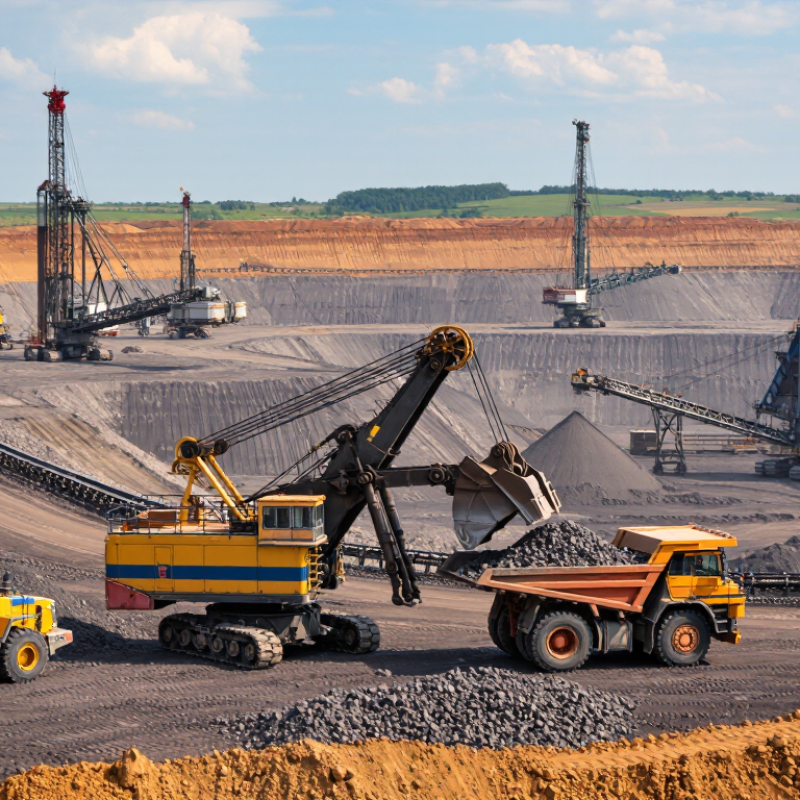
Surface mining depends on equipment working as a connected production system. Hydraulic excavators remove overburden and load blasted rock into haul trucks. Wheel loaders handle stockpiles, clean loading areas, and feed crushers when excavators are unavailable. Haul trucks move material along changing roads, where payload balance directly affects fuel use and cycle time. Dozers push waste, build safety berms, and maintain working faces. Their tracks provide useful traction on uneven ground.

Rotary drills create accurate holes for planned rock fragmentation and help operators control bench geometry. The drilling pattern matters more than machine size alone. Primary crushers reduce large run-of-mine rocks into manageable pieces. Conveyors then provide steady material flow between processing areas, reducing repeated truck movement. However, conveyors need careful alignment and regular inspection. Small mistracking problems can become costly stoppages. Motor graders shape haul roads, repair ruts, and maintain drainage slopes. A smooth road improves truck control and reduces tire stress.

Water trucks suppress dust around loading zones and haul routes, especially during dry shifts. They also support safer visibility, but excessive watering can damage road strength. Dewatering pumps remove groundwater from pits and sumps, protecting access routes and working surfaces. Field experience shows that capacity figures rarely tell the full story. A larger machine may underperform when roads, operators, maintenance access, or material conditions are poorly matched. Equipment selection needs production data, site measurements, service planning, and honest review of previous failures.

Top 10 Surface Mining Equipment Types Global Buyers Need - How Each Equipment Type Supports the Mining Process

Equipment Type Primary Function Mining Process Stage Typical Capacity or Performance Best-Fit Materials and Site Conditions How It Supports the Mining Process Key Purchasing Considerations
Hydraulic Excavator Breaks, digs, and loads blasted or excavated material. Overburden removal and ore loading Operating weights commonly range from approximately 20 to more than 800 metric tonnes; bucket capacities can range from about 1 to more than 60 m³, depending on class. Hard rock, overburden, coal, copper ore, iron ore, and other materials requiring high breakout force. Provides the primary digging and loading function at the pit face. Large hydraulic excavators can load haul trucks in several passes and support selective ore extraction. Match bucket size, loading height, bench geometry, hydraulic power, ground pressure, and truck body volume to the mine plan.
Mining Haul Truck Transports ore, waste rock, and overburden between the loading area and dump, crusher, or stockpile. Material haulage Rigid-frame haul trucks commonly cover payload classes from roughly 30 to more than 360 metric tonnes; operating speed is typically limited by payload, grade, and road conditions. Large open-pit operations with established haul roads and significant movement distances. Connects the pit to downstream processing and waste-disposal areas. Fleet availability and cycle time strongly influence total mine production. Evaluate payload, fuel or energy consumption, braking systems, tire availability, uphill speed, turning radius, and compatibility with loading equipment.
Wheel Loader Loads loose material, rehandles stockpiles, and feeds mobile or fixed crushing equipment. Loading, stockpiling, and plant feeding Common mining wheel loaders use buckets of approximately 3 to 40 m³, with operating weights ranging from about 15 to more than 250 metric tonnes. Crushed ore, aggregate, coal, limestone, sand, and short-distance loading applications. Offers fast mobility and flexible loading for stockpiles, blending areas, truck loading, and crusher-feed operations where excavation force is not the main requirement. Consider bucket fill factor, breakout force, lift height, travel distance, tire durability, fuel efficiency, and operator visibility.
Blast-Hole Rotary Drill Drills accurately spaced and sized holes for explosives or in-pit sampling. Drilling and blasting Surface rotary drills commonly cover hole diameters of approximately 150 to 450 mm, with drilling depths often reaching 15 to 60 m or more depending on the design. Competent rock formations in large open-pit mines, quarries, and construction-material operations. Creates the blast pattern that controls fragmentation, diggability, wall stability, and downstream loading and crushing performance. Assess hole diameter range, mast reach, compressor capacity, dust suppression, automation, terrain mobility, and performance in the target rock type.
Bulldozer Pushes overburden, spreads waste, maintains working areas, and constructs or repairs haul roads. Site preparation and material management Mining crawler dozers commonly range from approximately 150 to more than 900 kW, with blade capacities broadly ranging from about 10 to 70 m³ depending on blade type and material. Rough terrain, compacted waste, loose overburden, dumps, benches, ramps, and road-maintenance work. Maintains access and operating surfaces, supports truck and shovel productivity, pushes spillage, and helps prepare dumps and working benches. Select blade configuration, ripper capability, undercarriage strength, traction, ground clearance, slope performance, and service access.
Motor Grader Shapes, levels, crowns, and maintains haul roads and mine working surfaces. Haul-road construction and maintenance Typical mining motor graders use moldboards of approximately 3.7 to 7.3 m and engine outputs commonly ranging from about 130 to 350 kW. Long haul roads, ramps, benches, drainage channels, and surfaces requiring accurate grading. Improves road smoothness, drainage, tire life, vehicle speed, and braking safety, thereby reducing haul-cycle variation and operating costs. Review moldboard reach, articulation, steering control, automatic grade control, frame strength, and suitability for the mine's road width.
Surface Miner Cuts, crushes, and often loads or windrows material in a continuous operation without conventional drilling and blasting. Selective mining and material extraction Cutting widths commonly range from approximately 2.0 to 4.5 m, with cutting depths often adjustable from a few centimetres to about 0.8 m per pass, depending on machine design. Coal, gypsum, limestone, bauxite, phosphate, and other relatively continuous, stratified, or moderately soft deposits. Can improve selectivity and produce a more uniform feed size while reducing or eliminating blasting in suitable deposits. Check cutting drum design, production rate, dust control, material hardness, transfer method, grade capability, and maneuverability.
Dragline Excavator Removes large volumes of overburden and places waste at long reach using a suspended bucket. Overburden stripping Large draglines may use buckets of approximately 20 to more than 100 m³ and have working radii that can exceed 100 m, subject to machine configuration and mine geometry. Large, relatively flat coal deposits and operations where overburden can be cast directly into adjacent mined-out areas. Enables high-volume stripping and internal spoil placement, reducing the need for truck haulage in suitable overburden-removal layouts. Evaluate boom length, bucket capacity, digging depth, ground conditions, electrical infrastructure, relocation requirements, and mine sequencing.
Bucket-Wheel Excavator Continuously excavates soft to moderately consolidated material with a rotating bucket wheel and transfers it to a conveyor system. Continuous overburden and lignite mining Large systems can achieve theoretical excavation rates of several thousand to more than 10,000 m³ per hour, depending on material, wheel size, and system design. Large-scale lignite, brown coal, clay, sand, and other continuous deposits with relatively uniform geology. Supports continuous mining and conveyor transport, reducing dependence on truck fleets and enabling high-volume movement over stable mine layouts. Require detailed assessment of deposit continuity, mine geometry, material strength, conveyor integration, electrical supply, and system availability.
Water Truck Applies water to haul roads and active areas for dust suppression and surface conditioning. Environmental control and road management Mining water tanks commonly range from approximately 20,000 to more than 200,000 litres; spray coverage and cycle time depend on road width, climate, and traffic. Dry, windy, or high-traffic surface mines where airborne dust can affect visibility, safety, compliance, and equipment maintenance. Controls dust on haul roads, improves visibility, supports regulatory compliance, and helps maintain safer and more stable road surfaces. Consider tank capacity, pump and spray-bar output, water-source distance, nozzle control, chassis durability, and local water-management requirements.
Typical figures are indicative ranges for surface-mining equipment and vary with machine configuration, material properties, mine geometry, altitude, climate, duty cycle, and local operating standards. Actual production should be confirmed through a site-specific equipment and haulage study.

How to Compare Equipment by Capacity, Cost, and Site Conditions

Choosing surface mining equipment begins with production reality, not a catalog ranking. Compare haul trucks, hydraulic excavators, wheel loaders, dozers, graders, drills, crushers, conveyors, scrapers, and draglines against required output. Capacity figures need context. A 100-ton truck may move less material on a steep, wet haul road. Measure payload, cycle time, availability, and fuel use during typical shifts. Short-term peak capacity can mislead. Actual numbers matter.

Purchase price is only one part of cost. Calculate cost per tonne using fuel, tires, maintenance labor, spare parts, depreciation, and downtime. A lower-priced machine may need frequent servicing and reduce production. Ask for verified field data, service intervals, and realistic residual values. Use site trials when possible. A two-week trial can reveal overheating, poor visibility, or slow loading that a brochure will not show. This is where estimates often fail.

Match equipment to slope, bench width, material hardness, altitude, rainfall, and ground bearing capacity. Large excavators need stable working platforms; compact machines may perform better in narrow benches. Check turning radii and transport limits before purchase. Experienced operators should review the comparison, because their daily observations expose hidden risks. I would also record actual cycle times for several weeks, then revise the model. No spreadsheet stays perfect. Seasonal mud, unexpected rock, and training gaps can change the result quickly. Reliable decisions come from measured performance, transparent assumptions, and independent maintenance records.

How Global Buyers Can Select, Operate, and Maintain Equipment

Top 10 Surface Mining Equipment Types Global Buyers Need

Selecting surface mining equipment starts with the geology, not the catalogue. Buyers should match rotary drills, hydraulic excavators, wheel loaders, haul trucks, dozers, graders, scrapers, crushers, conveyors, and water trucks to bench height, haul distance, material hardness, and rainfall. The U.S. Geological Survey reported approximately 22 million tonnes of mined copper production in 2023. That scale shows why small productivity losses can become major costs. A practical trial should measure tonnes per hour, fuel use, tire damage, and operator visibility on the actual site.

Operate with discipline. Before each shift, inspect brakes, steering, alarms, hydraulic lines, guards, and fire systems. Keep haul roads crowned and watered, but avoid excessive spray near ramps. The U.S. Mine Safety and Health Administration recorded 40 mining fatalities in 2023, reinforcing the need for controlled traffic and reliable maintenance. Use separate routes where possible. Shortcuts are expensive.

Maintenance should follow operating hours and condition data, not guesswork. Track oil particles, vibration, coolant temperature, payload accuracy, and unscheduled stops. The 2024 Deloitte Mining and Metals Tracking the Trends report highlights productivity, resilience, and digital capability as continuing industry priorities. Yet sensors cannot replace experienced mechanics. I have seen clean dashboards hide loose electrical connections. Review failures weekly, store critical filters and hoses locally, and train operators to report unusual noise early. Good plans still need revision.