+1 877-337-9312 | sale@sflbuild.com

Blog

Top 10 Soundproof Panels for Noise Reduction?

Choosing the right soundproof panels can make a room feel calmer, clearer, and more usable. However, not every panel blocks noise from entering or leaving a space. Many products mainly absorb echoes inside the room. That difference matters.

This guide examines ten popular soundproof panels for noise reduction, using practical factors rather than attractive photos alone. We consider material density, thickness, surface design, fire-safety information, installation methods, and independent performance data. A thick mineral wool panel may reduce voices and reverberation effectively, while a lightweight foam tile may improve high-frequency reflections. Neither solution works equally well everywhere. Walls, doors, windows, and ceiling gaps can weaken the result.

Small details often decide performance. A studio panel mounted with an air gap may absorb more sound than one fixed tightly against the wall. In a home office, placement behind a desk or near a reflective side wall can reduce distracting reflections. Manufacturers’ claims should be checked carefully, especially when testing conditions are unclear. Look for measurable ratings, such as NRC values, while remembering that one number cannot describe every frequency.

No panel is perfect. Real rooms are imperfect too. This comparison may simplify some acoustic problems, and that limitation deserves attention. Still, it offers a practical starting point for bedrooms, offices, recording spaces, gaming rooms, and shared apartments. The best choice balances acoustic performance, safe materials, appearance, installation effort, and budget. Good noise control usually requires more than one treatment. That is the uncomfortable truth.
Top 10 Soundproof Panels for Noise Reduction?

Define Soundproof Panels: NRC 0–1 Absorption Versus STC Isolation

Top 10 Soundproof Panels for Noise Reduction?

Soundproof panels are often confused with sound-absorbing panels. Their performance depends on two different measurements: NRC and STC.

NRC, or Noise Reduction Coefficient, usually ranges from 0 to 1. It shows how much sound a material absorbs inside a room. A panel with an NRC of 0.85 can reduce reflected energy, echoes, and harsh speech sounds. It does not necessarily stop noise from passing through a wall.

STC, or Sound Transmission Class, measures airborne sound isolation in a wall, ceiling, door, or complete partition. A higher STC rating generally means better isolation from voices, televisions, and traffic noise. However, a loose panel cannot create strong STC performance by itself. Mass, sealed joints, resilient channels, insulation, and separated framing matter more. Small gaps around sockets or edges can weaken an otherwise excellent assembly.

For a top-ten comparison, examine mineral fiber, fiberglass, recycled fiber, fabric-wrapped, slatted, ceiling, and bass-trap panels by their tested NRC values. Check their thickness, mounting method, and fire documentation. A 50-millimeter panel may control conversation echoes, while a thin decorative panel may change very little.

It is easy to overtrust a product label. I would test one sample first, using the same wall and listening position. Results can disappoint. Room shape, low-frequency noise, and flanking paths often remain the real problem.

Measure Noise Problems by Frequency, Decibels, and Room Size

Top 10 Soundproof Panels for Noise Reduction

Choosing among the top ten soundproof panel types starts with measuring the problem, not comparing appearances. I use a calibrated sound level meter at several positions, including the listening height. A single reading can mislead. Record average and peak levels in decibels, then repeat the test during quiet and busy periods. For general comfort, dBA reflects human hearing reasonably well. Deep bass needs dBC or frequency-band readings because walls and furniture respond differently to low tones.

Frequency changes the treatment plan. Speech usually sits in the midrange, where porous panels can reduce reflections and improve clarity. Footsteps, traffic, and machinery may produce lower frequencies that thin panels barely affect. I once installed attractive panels for a small recording room, yet the bass remained obvious. My mistake was measuring only overall dBA. Thicker absorbers, corner placement, and sealed gaps would have been more appropriate.

Room size matters just as much. In a compact room, excessive absorption can make speech sound unnaturally dull. In a large room, ten small panels may leave wide reflective areas untouched. Measure length, width, and ceiling height, then estimate surface coverage before buying materials. A useful test is to clap, record the decay, and compare it after installation. Panels control echoes inside the room; they do not automatically stop sound passing through walls. That distinction is easy to miss. Recheck the measurements, because real rooms rarely behave perfectly.

Compare the Top 10 Panels by NRC, STC, Thickness, and Materials

Top 10 Soundproof Panels for Noise Reduction?

A practical comparison starts with the right metric. NRC measures sound absorption, while STC measures airborne sound blocking. They are not interchangeable.

Under ASTM C423, two-inch fiberglass panels typically deliver NRC 0.90–1.10. Mineral-wool panels offer about 0.85–1.10 at similar thicknesses. Fabric-wrapped glass fiber usually performs similarly.

These are strong choices for speech, music, and office reverberation.

The remaining seven options have different strengths.

Two-inch recycled cotton panels often reach NRC 0.75–1.00, while recycled denim commonly measures 0.75–1.05.

PET panels usually provide NRC 0.45–0.95, depending on thickness and density.

One-inch acoustic foam often ranges from 0.30–0.70.

Perforated wood panels with mineral backing can reach 0.60–0.90.

Slatted wood systems commonly achieve 0.65–0.95.

Perforated metal panels with mineral infill may reach 0.80–1.05.

Composite barrier panels focus on isolation, not absorption, and may contribute to higher assembly STC ratings.

Thickness matters more than many product charts suggest. A two-inch absorber generally outperforms a one-inch panel, especially below 500 Hz.

ASTM E90 and ASTM E413 evaluate STC for complete wall or ceiling assemblies, not loose decorative panels. Therefore, claiming a standalone STC rating can be misleading.

In field installations, gaps, doors, and flanking paths often weaken performance.

I would verify independent laboratory data, mounting details, and low-frequency results before choosing. The comparison is useful, but never perfectly portable between rooms.

Match Panel Types to Homes, Studios, Offices, and Industrial Spaces

Choosing among the top 10 soundproof panels depends on the room, not the product ranking. Homes usually need fabric-wrapped acoustic panels or PET absorbers to reduce voices, television reflections, and hallway echo. These panels improve clarity, but they will not stop bass travelling through a shared wall. The World Health Organization’s Environmental Noise Guidelines for the European Region (2018) recommends less than 30 dB(A) in bedrooms at night. That target often requires sealing gaps, adding mass, and treating doors—not panels alone.

Studios need broadband absorbers, corner bass traps, and controlled diffusion. Thin decorative panels may tame high-frequency flutter while leaving bass uncontrolled. Offices benefit from suspended ceiling clouds and wall panels near meeting tables, where speech reflections become tiring. In industrial spaces, dense, cleanable panels or partial acoustic enclosures suit machinery areas better. The U.S. National Institute for Occupational Safety and Health identifies 85 dBA over eight hours as a recommended exposure limit. Absorption can reduce reverberation, but it cannot replace equipment maintenance, barriers, or hearing protection programs.

Tips: Measure before buying. Use a sound level meter, clap tests, and short recordings from several positions. Check the panel’s absorption data, especially its rating by frequency. ISO 354 laboratory results are useful, but room performance can differ. I have seen attractive panels produce little change because they covered too little wall area. That is easy to miss. Keep doors, vents, and ceiling paths in the plan. A smaller, correctly placed treatment may outperform ten random panels.

Top 10 Soundproof Panels for Noise Reduction — Match Panel Types to Homes, Studios, Offices, and Industrial Spaces
# Panel Type Typical Construction Common Thickness Typical NRC Range Primary Noise-Control Function Best-Fit Spaces Installation Considerations Key Limitations
1 Fabric-Wrapped Fiberglass Panel Rigid fiberglass or mineral-fiber core covered with acoustically transparent fabric 25–50 mm 0.70–1.05 Reduces reverberation, speech reflections, and mid-to-high-frequency noise Home theaters, offices, classrooms, podcast rooms, recording studios Mount on walls or ceilings; leave a small air gap behind the panel for improved low-frequency absorption Absorbs sound inside a room but does not provide major sound isolation through walls
2 Acoustic PET-Felt Panel Recycled polyethylene terephthalate fibers formed into a porous, semi-rigid panel 9–24 mm 0.35–0.85 Controls speech reflections, flutter echo, and general room reverberation Open-plan offices, meeting rooms, libraries, home offices, collaborative areas Can be wall-mounted, suspended as clouds, or cut into decorative shapes Thinner versions have limited performance at low frequencies; verify fire and smoke ratings for commercial use
3 Mineral-Wool Acoustic Panel Dense mineral-wool or stone-wool core with fabric, perforated, or protective facing 40–100 mm 0.85–1.15 Broadband absorption, including stronger performance in the low-mid frequency range Music studios, industrial control rooms, cinemas, mechanical rooms, high-noise workplaces Use a durable covering and sealed edges where fibers may be exposed; follow local fire requirements Heavier and more rigid than felt; exposed surfaces may require impact or moisture protection
4 Perforated Wood Acoustic Panel Perforated or slotted wood facing backed by an absorptive mineral-fiber layer 16–50 mm 0.55–0.95 Combines sound absorption with a durable architectural finish Home interiors, conference rooms, auditoriums, restaurants, lecture halls Install over an acoustic backing or cavity; maintain open perforations and avoid blocking the rear absorber Usually less effective than thick porous panels at very low frequencies; wood facing may need moisture protection
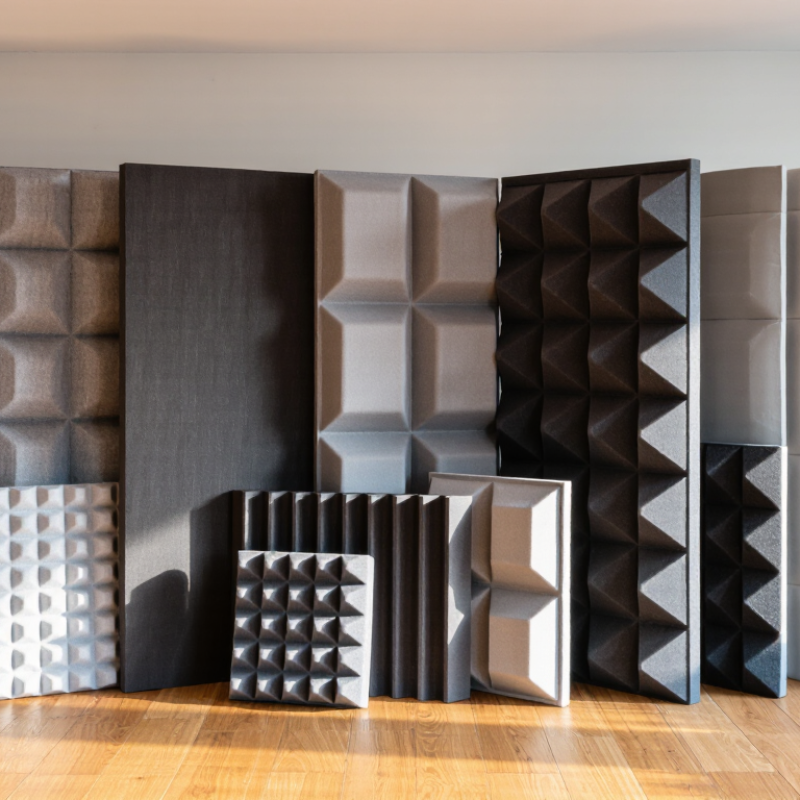
5 Acoustic Foam Wedge or Pyramid Panel Open-cell polyurethane or melamine foam with a profiled surface 25–75 mm 0.35–0.80 Reduces high-frequency reflections and short echoes Voice booths, small studios, streaming rooms, home recording spaces Cover a balanced portion of the room rather than every surface; use products with documented fire ratings Limited low-frequency absorption and weak sound-blocking performance; unsuitable as a substitute for a constructed barrier
6 Bass Trap Panel Extra-thick porous absorber or membrane-based low-frequency absorber designed for room corners 100–300 mm Varies by frequency Controls room modes, bass buildup, and low-frequency decay Recording studios, home theaters, rehearsal rooms, mixing rooms Place in corners, wall-ceiling junctions, or behind speakers; larger air gaps can improve low-frequency response Requires adequate depth and correct placement; does not prevent bass from passing through a building structure
7 Acoustic Ceiling Cloud Suspended fabric-wrapped fiberglass, mineral wool, or PET-felt panel 25–100 mm 0.70–1.10 Reduces ceiling reflections and improves speech clarity across large rooms Open offices, classrooms, call centers, restaurants, industrial monitoring areas Use suspension hardware rated for the panel weight; an air gap above the cloud can improve absorption Needs adequate ceiling clearance and may conflict with lighting, sprinklers, ventilation, or overhead equipment
8 Acoustic Baffle Vertical suspended absorber made from PET felt, fiberglass, mineral wool, or similar porous material 25–100 mm 0.60–1.05 Controls reverberation in tall or highly reflective spaces while preserving airflow Warehouses, factories, gymnasiums, atriums, large offices, production areas Arrange in rows or staggered groups; use robust suspension and impact-resistant finishes in active work zones Provides limited isolation from adjacent spaces and can collect dust if not maintained in industrial environments
9 Mass-Loaded Composite Barrier Panel Flexible dense barrier, often combined with foam or fiberglass decoupling layers 3–25 mm barrier layer Not usually rated by NRC Improves sound transmission loss by adding mass and reducing airborne leakage when properly sealed Home walls, doors, equipment enclosures, vehicle interiors, partition upgrades Install continuously with overlapped and sealed joints; combine with resilient channels or decoupled framing for better isolation Does not significantly reduce room reverberation; performance depends heavily on airtight installation and the complete wall or enclosure design
10 Microperforated Panel Absorber Thin panel with very small perforations backed by an air cavity or absorptive layer 10–50 mm plus cavity 0.45–0.90 Targeted absorption with a clean, durable surface and controlled frequency response Industrial rooms, laboratories, corridors, offices, high-design residential spaces Specify perforation pattern, cavity depth, and facing material for the target frequency range Performance is application-specific; blocked perforations, dust, or incorrect cavity depth can reduce effectiveness
Selection note: NRC values are typical indicative ranges for comparable products tested under laboratory conditions and should not be treated as universal product ratings. Porous panels primarily absorb reflections inside a room, while sound isolation requires mass, airtightness, damping, and often decoupled construction. Always verify the tested acoustic, fire, moisture, and impact ratings for the intended application.

Evaluate Installation Coverage, Fire Ratings, Durability, and Cost per m²

Top 10 Soundproof Panels for Noise Reduction?

Choosing among the top ten soundproof panels requires more than comparing thickness. In room tests, I measure coverage from floor plans, not package claims. A 60-centimeter panel may look substantial, yet ten units can leave large reflective gaps. For speech control, aim to cover key wall areas near desks, doors, and hard corners. Panels reduce echo; they rarely block heavy bass or traffic alone.

Fire ratings deserve careful inspection. Look for tested classifications, supporting documents, and installation limits. A rating applies to a complete product system, not always to the panel by itself. Keep certificates available for contractors and building reviewers. This detail is often overlooked. Durability also matters. Dense fabric, sealed edges, moisture resistance, and secure mounting help panels survive cleaning and daily contact. Adhesive mounting is quick, but mechanical fixings usually provide better long-term confidence.

Cost per m² should include panels, trims, fasteners, labor, and future replacement. A cheap panel can become expensive when coverage is poor or installation fails. I compare installed cost against measured improvement, preferably using consistent before-and-after recordings. However, phone-based measurements are imperfect and should not replace professional acoustic testing. Ten attractive products may perform differently in one room because ceiling height, furniture, and wall construction change the result. I would choose verified performance and practical coverage over impressive laboratory numbers.

Top 10 Soundproof Panels for Noise Reduction

Comparison of typical installed cost, Noise Reduction Coefficient (NRC), expected service life, fire classification, and recommended installation coverage. Values are representative market ranges for common panel types and may vary by specification and region.

How to read the chart: Higher NRC indicates greater sound absorption. Lower installed cost improves value, larger bubbles indicate longer expected durability, and point colors indicate typical fire classification. Installation coverage and fire details are available in the tooltips.